
Now Available for Purchase
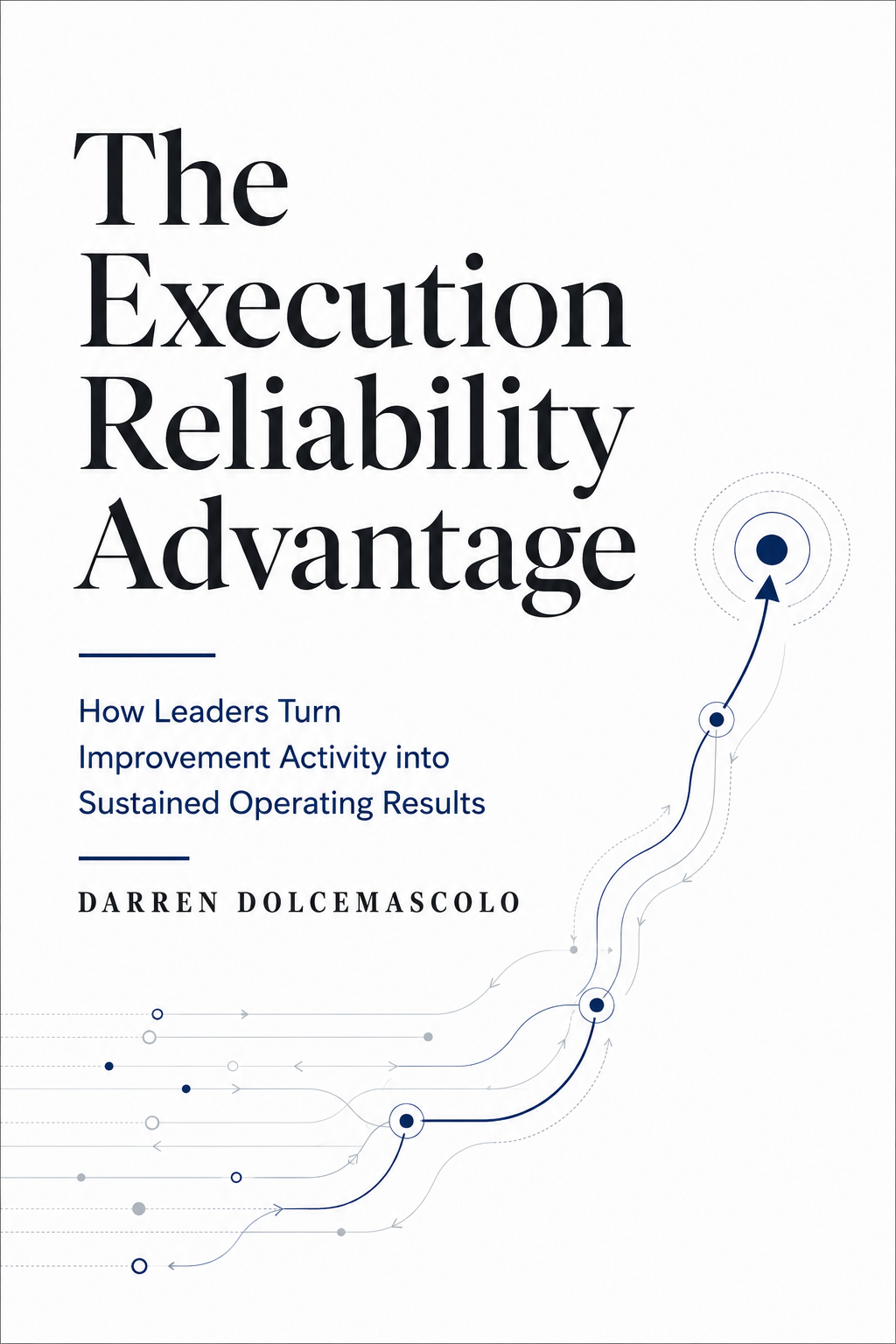
The Execution Reliability Advantage is now available on Amazon in Kindle, paperback, and hardcover editions.
How leaders turn improvement activity into sustained operating results.
Many organizations have improvement activity — training, projects, dashboards, huddles, action plans, and Lean/CI efforts — but still struggle to convert that activity into sustained business performance. The Execution Reliability Advantage explains why good improvement work often fails to stick and what leaders can do to connect improvement activity to business conditions, leadership ownership, operating cadence, problem-solving discipline, and follow-through.
Early Endorsement Excerpts
“Darren's Execution Reliability framework provides leaders with a practical and disciplined approach for closing the gap between activity and performance.”
Dave MowryChief Executive OfficerBreg, Inc.
“I recommend this book to any executive or operations leader responsible for converting continuous improvement into measurable, sustainable success.”
Rob GledhillPresident & CEOBlue-White Industries, Ltd.
“Under his guidance, we increased productivity by 40% and significantly reduced waste across our operation.”
Jeff MasonCOOFlux Power
“Leaders responsible for operational performance will find its practical guidance invaluable in creating meaningful and lasting improvements.”
Kelly KempSr. Director, Process Development EngineeringVertex Pharmaceuticals
About the Book
Improvement Activity Is Not the Same as Execution Reliability
Organizations do not usually fail at improvement because they lack tools. They fail because the tools are not connected to the business condition, leadership ownership, operating cadence, problem-solving discipline, capability building, and follow-through needed to turn activity into performance.
The book is written for executives, operating leaders, CI sponsors, HR and learning leaders, project sponsors, and internal improvement professionals who want improvement work to produce measurable and sustainable value.
Who This Book Is For
The Execution Reliability Advantage is written for people who need improvement work to translate into measurable, sustained operating performance.
How Execution Reliability Fits with Lean, TPS, Six Sigma, and Shingo
Many organizations already have Lean tools, Six Sigma projects, operational excellence programs, or cultural improvement frameworks. These methods can be valuable. The problem is that they do not always translate into sustained business performance.
The Execution Reliability Advantage addresses the leadership layer around improvement work. It helps leaders connect improvement activity to the business condition, measurable value, system view, problem-solving discipline, capability building, leadership ownership, operating cadence, and follow-through.
TPS and Lean help organizations improve flow, quality, cost, delivery, and stability. Six Sigma helps organizations reduce variation and improve process performance. The Shingo Model emphasizes principles, behaviors, and culture. Execution Reliability focuses on the operating discipline that helps leaders turn those efforts into sustained results.
Execution Reliability does not replace Lean, TPS, Six Sigma, or Shingo. It helps leaders ask a different question: Are our improvement efforts connected to the condition the business needs to improve, and do we have the leadership system required to sustain the results?
Companion Toolkit
A companion set of downloadable resources will be available to help readers apply the book's ideas. The toolkit is designed to help leaders diagnose where execution reliability is breaking down and begin with a practical next step.
- Execution Reliability Diagnostic
- Business Condition Clarifier
- Agreement Before Action Checklist
- Leadership Cadence and Follow-Through Planner
- 90-Day Execution Reliability Roadmap
Put the Ideas from the Book to Work
Execution Reliability Review
The Execution Reliability Review is a focused executive review for leaders who want to identify where priorities, improvement activity, leadership routines, and follow-through are not translating into sustained operating results.
It is designed as a practical next step for leadership teams that want an outside view of their execution system without beginning with a full operational diagnostic or broad transformation effort.
Join for updates and monthly briefs
Join the Execution Reliability email list for monthly briefs, tools, and practical resources on turning improvement activity into sustained operating results.
A practical operating model for turning improvement activity into execution reliability
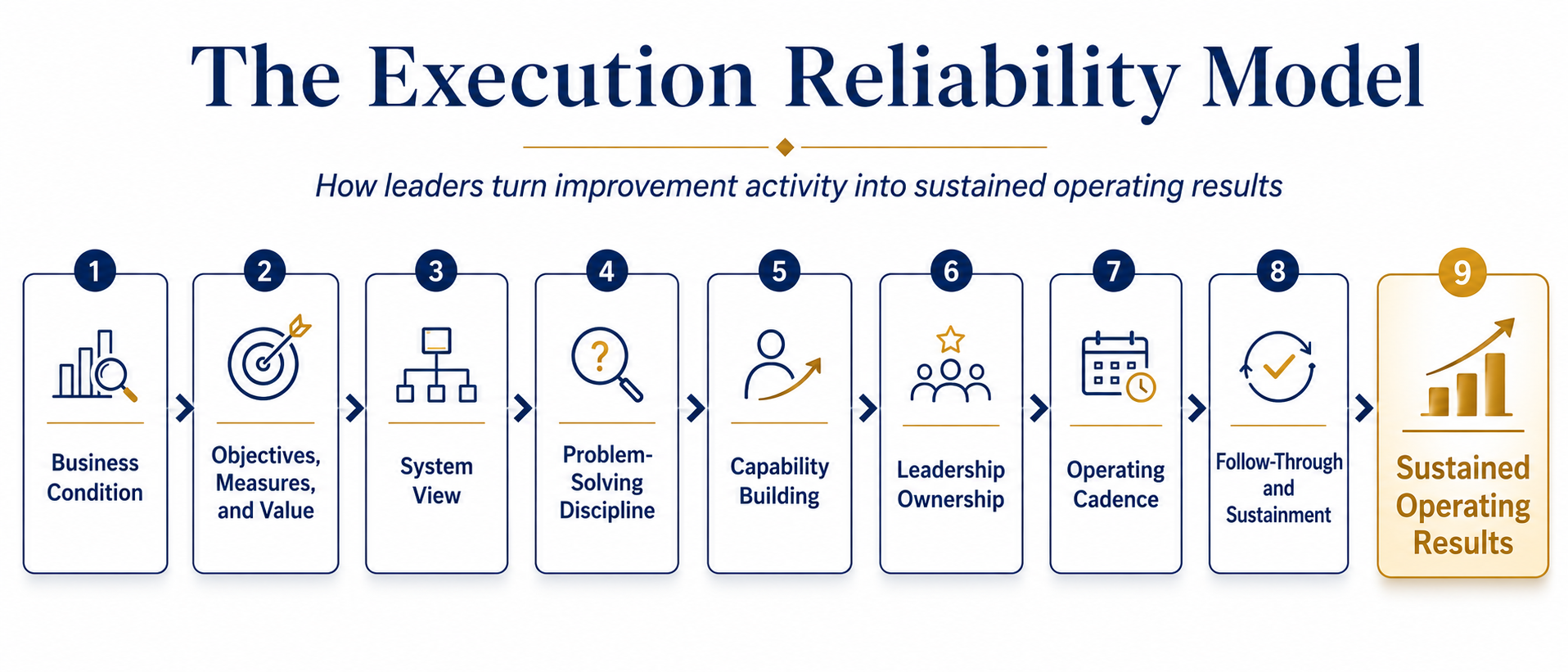
The Execution Reliability model connects the business condition, objectives and measures, system view, problem-solving discipline, capability building, leadership ownership, operating cadence, and follow-through into one practical leadership system.
The book explains how these pieces work together and how leaders can use them to diagnose why improvement work does—or does not—become sustained business performance.
The Execution Reliability Model
The book is organized around a practical operating model for diagnosing why improvement work does or does not become sustained business performance.
- Business Condition — What needs to improve?
- Objectives, Measures, and Value — What will be different, how will we know, and why does it matter?
- System View — What flow of work, decisions, handoffs, and constraints produces the current result?
- Problem-Solving Discipline — How will the organization understand causes and test countermeasures?
- Capability Building — What must people learn, practice, and apply in the work?
- Leadership Ownership — Who owns the operating system and the result?
- Operating Cadence — How will performance, problems, escalation, and support be reviewed?
- Follow-Through and Sustainment — How will action become completed, verified, standardized, and sustained?
Early Praise for The Execution Reliability Advantage
The challenge facing many organizations is not a lack of improvement initiatives, but the inability to consistently translate those initiatives into sustained business results. Darren's Execution Reliability framework provides leaders with a practical and disciplined approach for closing the gap between activity and performance, emphasizing leadership ownership, operating cadence, capability building, and follow-through.
Dave MowryChief Executive OfficerBreg, Inc.
The Execution Reliability Advantage offers leaders practical guidance on establishing clear business focus, leadership ownership, operating cadence, and rigorous follow-through to turn improvement efforts into lasting performance. This message aligns closely with our work building Be-WISE as our company's operating system.
I recommend this book to any executive or operations leader responsible for converting continuous improvement into measurable, sustainable success.
Rob GledhillPresident & CEOBlue-White Industries, Ltd.
I had the privilege of working directly with Darren Dolcemascolo of EMS Consulting Group as we implemented Lean operations strategies at Flux Power. Under his guidance, we increased productivity by 40% and significantly reduced waste across our operation — results that came not from theory, but from disciplined, repeatable execution on the floor.
That same practical rigor comes through on every page of The Execution Reliability Advantage. Darren has a rare ability to turn Lean principles into concrete actions that teams can actually sustain, and this book distills the methods that delivered real, measurable improvement in our business. Any leader serious about building an operation that performs reliably — day in and day out — will find it indispensable.
Jeff MasonCOOFlux Power
The Execution Reliability Advantage addresses one of the most common gaps in operational improvement: the difference between improvement activity and sustained business performance. Darren's focus on starting with the business condition, then connecting the work to ownership, cadence, problem solving, and follow-through, is practical and highly relevant for executives and operations leaders. This book gives leaders a clear operating lens for turning good improvement work into measurable and sustainable results.
Sorin GorganSr. VP, Manufacturing OperationsBroadata Communications, Inc.
The Execution Reliability Advantage is an essential read for leaders and professionals striving to bridge the gap between improvement activity and sustained business performance. It emphasizes the critical importance of identifying the underlying business condition before selecting tools or solutions, ensuring that improvement efforts are targeted and impactful. By advocating for cross-functional input and disciplined problem-solving, the book helps prevent short-term fixes and fosters long-term, reliable execution. Leaders responsible for operational performance will find its practical guidance invaluable in creating meaningful and lasting improvements.
Kelly KempSr. Director, Process Development EngineeringVertex Pharmaceuticals
Whether you are new to Lean or have years of experience leading improvement efforts, this book addresses a challenge many organizations face: turning good ideas into lasting results. Darren provides a practical framework for understanding why improvement efforts stall and what leaders can do to sustain change and drive measurable business performance. This is a valuable resource for anyone responsible for improving operations and delivering results.
Jesse RendonVP of OperationsCEMCO
Darren describes a problem that I know very well from my own experience: improvement work that begins with energy but does not reach the business result. At RE:CIRCLE, the improvements that lasted — including our pre-consumer food waste diversion work — lasted because of exactly what this book asks for: leadership ownership, a regular operating cadence, and follow-through that confirms what has really changed in the work. I recommend this book to every executive who is no longer satisfied with improvement activity that does not translate into sustained performance.
Clemens J. StockreiterFounderRE:CIRCLE Solutions
Related Resources
The book connects to EMS Consulting Group's current executive point of view on moving from improvement activity to execution, using AI to support coaching, and building leadership routines that help improvement stick.